
October 2, 2026
God Hasn’t Left Yet
Share This Note
About Italy, the Church and a faith that lingers long after belief
If you turn up at someone’s house in Italy at the end of October carrying a bunch of chrysanthemums, you’d better have a very good explanation. In the Netherlands, they sit happily enough alongside roses and tulips. Here, they belong to the dead.
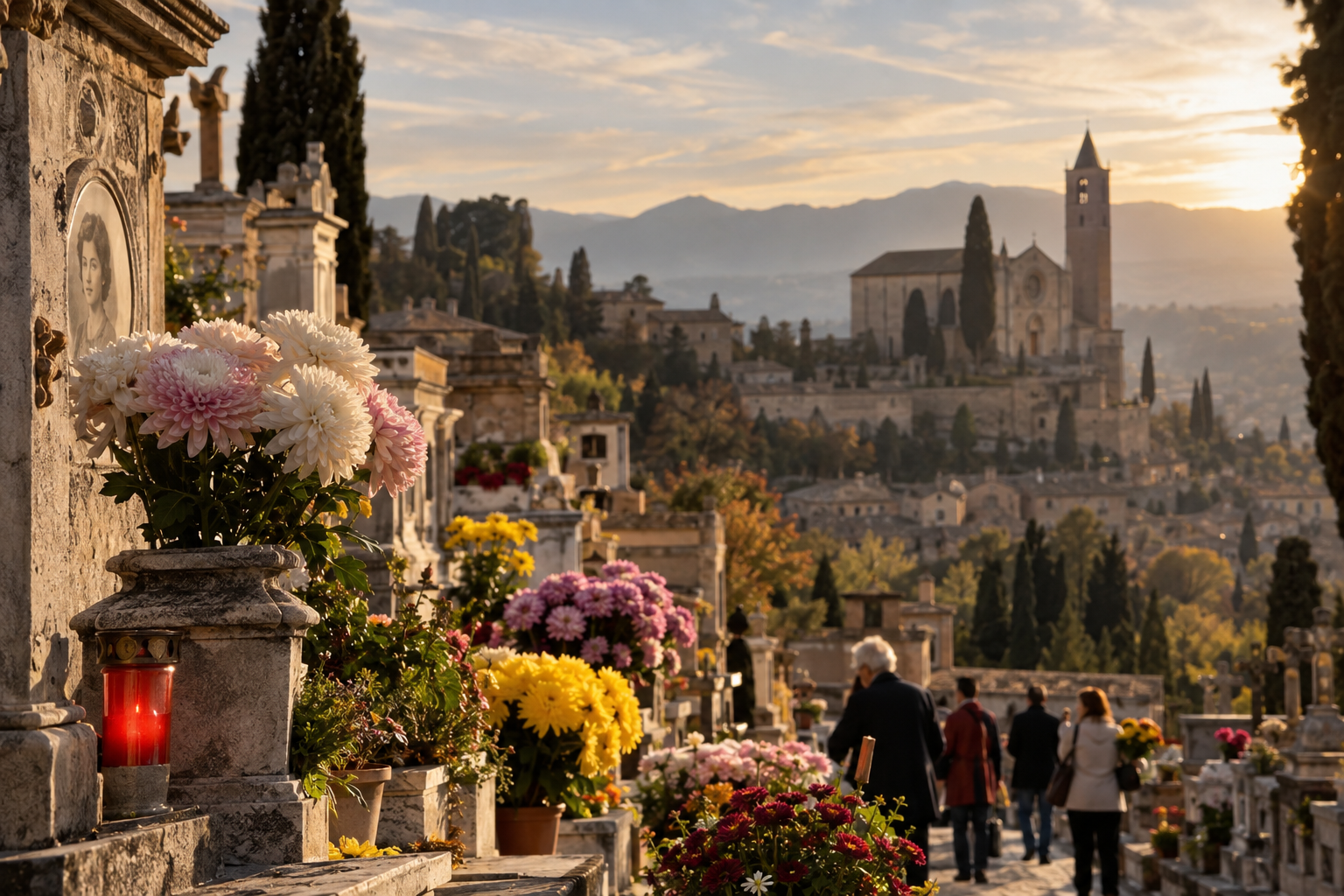
They flower late, last for ages and have long been the flowers people take to the cemetery around Ognissanti, All Saints’ Day on 1 November, and la Commemorazione dei Defunti on 2 November, usually known simply as i Morti, the Dead. The connection with cemeteries and mourning is now so strong that giving chrysanthemums to your hostess can go down rather badly. If she’s superstitious, there may well be some frantic touching of wood or another gesture to ward off bad luck. Anything to get rid of the uncomfortable suggestion that you’ve just brought her flowers intended for her own grave.
Around i Morti, you see where those flowers really belong. Cemeteries fill with families, sometimes three generations at once. Graves are cleaned, vases filled, photographs dusted. Between the headstones, people run into neighbours and acquaintances who have come to do exactly the same thing. Someone crosses themselves, someone says a prayer, someone else simply stands quietly for a moment. Then the conversation turns to the children, an illness, the grandchildren and everything that has happened since they last met. The line between remembrance and ordinary social life is less clear-cut than we tend to make it in northern Europe. Even among the dead, Italian life remains remarkably lively.
Many of the people carrying those flowers won’t have been anywhere near a church the Sunday before. Some still call themselves Catholic, others cattolico non praticante, non-practising Catholics, and some hardly believe at all. Yet they visit their parents’ graves because their parents did the same, and their grandparents before them. Over the generations, the Catholic idea of a bond between the living and the dead has become mixed up with family, memory and tradition. You don’t necessarily have to believe what your grandparents believed to carry on doing what they did.
That’s true of much of Italy. Faith is fading faster than the world the Church built around it. Stop believing in God and the church towers don’t disappear from the landscape. The frescoes stay on the walls, the roadside chapels remain beside the lanes and the monasteries are still there on the hilltops. Saints’ names live on in families, Catholic feast days stay in the calendar and churches still occupy the best spot in almost every old town. Even if you want absolutely nothing to do with religion, it is difficult to avoid its physical presence. The church is quite literally in the middle of the square, often defines the skyline of a village and, from many a hilltop, still looks down over everything below.
The calendar is just as stubborn. Christmas and Easter are obvious, but 6 January brings Epifania, on 15 August Ferragosto coincides with the Assumption of the Virgin Mary, 1 November is Ognissanti and 8 December the Immacolata Concezione, the Immaculate Conception. Then almost every town and village has its own patron saint, whose feast day may even mean a local day off. Italy is officially a secular republic, but even the most committed atheist rarely complains when the Immaculate Conception gives him a free day in December.
The saints haven’t quite disappeared from everyday life either. If you lose something, you can obviously look for it, although asking Sant’Antonio for a little help won’t hurt. Santa Lucia looks after the eyes, San Giuda Taddeo takes on hopeless causes and San Francesco has the animals. Every town seems to have its own heavenly favourite too, sometimes defended with a loyalty suspiciously similar to that shown to the local football team.
An Italian can spend ten minutes explaining that he isn’t remotely religious, then suggest lighting a candle because somebody is having an operation. Faith, habit and a touch of non si sa mai, you never know, rub along perfectly well here.
Even people’s names carry the past with them. Francesco, Giuseppe, Giovanni, Antonio, Lucia, Chiara, Maria: generations of children were named after saints, often while also being named after a grandparent, neatly joining heaven to the family tree. Your name came with an onomastico too, the feast day of your saint. Some families still celebrate it; in others, it at least earns you a phone call and an auguri. A country that likes family, food and feast days was never likely to object to another excuse to put something on the table.
It’s strange to think that all this began with a small religious minority in the Roman Empire. Christianity wasn’t heritage then. At times, being a Christian was dangerous. Christians were persecuted in several periods and, according to Christian tradition, both Peter and Paul were martyred in Rome. Things changed dramatically in the fourth century. Constantine gave Christianity legal recognition and, by the end of that century under Theodosius I, Nicene Christianity had become the official religious norm of the Roman Empire.
The Western Roman Empire eventually fell apart. The Bishop of Rome did not. Emperors disappeared, borders shifted and Lombards, Franks, Normans and others came and went. Italy remained divided for centuries between kingdoms, republics, duchies and city-states, while the Pope’s spiritual and political power continued to grow. Eventually, popes ruled their own Papal States, stretching across large parts of central Italy, including areas of what are now Lazio, Umbria, Marche and Emilia-Romagna.
Drive through central Italy today and you can still see that history everywhere. An abbey on a hill, a monastery behind thick walls, a bishop’s palace beside the cathedral, a papal coat of arms above an old city gate. Religion is written all over the landscape. Religious orders also owned and managed land, ran schools and orphanages, cared for the poor and worked in hospitals. Monasteries were places of farming, learning and education, and nuns continued to play an important part in Italian healthcare well into the twentieth century.
For centuries, the Church was there at almost every important moment of your life. Soon after birth came baptism, followed by confession, First Communion and confirmation. You married in church and, eventually, were buried by it. Parish records kept track of births, marriages and deaths long before the modern state took over the paperwork. The Church was there beside the cradle, at the wedding and, in the end, at the grave. And it certainly didn’t lose interest in what happened in between.
Catholic teaching shaped ideas about marriage, sex, family life and what was considered respectable or sinful. Marriage was for life, sex belonged within marriage and was closely linked to having children, and men and women were expected to play very different roles. For women especially, those expectations could be unforgiving. A pregnancy outside marriage could damage the reputation of an entire family, and an unhappy marriage remained a marriage. Divorce simply wasn’t legal in Italy until 1970.
Real life, of course, has never followed the catechism quite as neatly as the Church might have liked. And there lies one of Italy’s more entertaining contradictions. This is, after all, the country that spent centuries exporting Catholic sexual morality to the rest of the world while producing an impressive number of songs, films, scandals and family stories suggesting that daily life occasionally followed its own rules. The priest knew a lot, nonna probably knew more.
Mothers, meanwhile, came to occupy an almost untouchable place in Italian family life. It would be too easy to blame, or credit, the famous Italian mammismo entirely on the Church. Economics, regional family traditions, children leaving home late and a welfare system that has often relied heavily on families all played their part. But the Catholic image of Mary certainly helped shape ideas about women and motherhood over the centuries.
And Mary herself is almost impossible to avoid. She is in churches and chapels, of course, but also in niches in house walls and little shrines beside the road. Sometimes she has a plastic flower, sometimes an electric candle, sometimes a fresh bunch of flowers that makes you wonder who stopped on their way to work that morning to put them there.
Even dinner wasn’t safe from the Church calendar. Centuries of fasting and abstinence decided when meat could and couldn’t appear on the table and left their mark on regional cooking. Christmas Eve was traditionally di magro, without meat; Easter brought back lamb, eggs and richer food.
Here in Umbria, cappelletti in brodo di cappone still belong to Christmas, often after a family pasta-making session around the spianatoia that produces enough cappelletti to feed a small army. Even the clergy manage to appear in this story. One old explanation links the name cappelletti to their resemblance to a small clerical hat, while an account from 1811 tells of priests competing to see who could eat the most. Religious restraint apparently had its limits once a good broth was on the table.
For centuries, the Church even helped tell people what time it was. Bells called people to Mass, announced weddings and deaths, warned of danger and marked the hours long before everyone had a clock at home. In the Italian countryside they sometimes still perform that last duty with an enthusiasm that pays little attention to anyone who, at seven in the morning, feels no particular need for either a time check or spiritual guidance.
So the Church shaped the way Italians ate, married, mourned, celebrated, raised children and thought about right and wrong. When Italy finally became a nation in the nineteenth century, it wasn’t simply a question of joining a collection of kingdoms and states together. There was also the small matter of the Pope, who happened to rule a large part of the country the new Italy wanted for itself.
The Kingdom of Italy was proclaimed in 1861, although Rome and some other parts of modern Italy were still missing. Rome remained under papal rule until Italian troops entered the city in 1870, and the following year it became the capital. Pope Pius IX refused to accept the new situation and regarded himself as a prisoner of the Vatican. After centuries of division, Italy had finally got itself a capital and immediately fallen out with its most famous resident.
The Roman Question dragged on for almost sixty years. It was only in 1929 that Pope Pius XI and Benito Mussolini’s Fascist government reached an agreement. Under the Lateran Treaties, the Holy See recognised the Kingdom of Italy with Rome as its capital, while Italy recognised Vatican City as an independent sovereign state. Catholicism also became Italy’s state religion. And so a tiny independent country of about 44 hectares came into being right in the middle of Rome: smaller than many Italian farms, but rather more influential than most of them.
In 1984 the Concordat was revised and Catholicism stopped being Italy’s official state religion. The Constitution had already, since 1948, recognised the State and the Catholic Church as independent and sovereign within their own spheres, while also protecting other religions. On paper, then, Church and State are separate.
After nearly two thousand years together, however, they still seem to have quite a few shared arrangements. At times it feels rather like an Italian divorce: officially they live in separate houses, but they still have each other’s keys and regularly interfere with what’s going on next door.
You can see it in state schools, where insegnamento della religione cattolica, Catholic religious education, is still offered. Children don’t have to take it, but the subject remains part of the system under agreements between Church and State, with the Italian Bishops’ Conference involved in how it is organised. The official reasoning includes the fact that Catholicism forms part of Italy’s historical heritage. And in many classrooms, somewhere clearly visible, above a door, on a wall, traditionally often near the blackboard, there is still a crucifix. That little cross has had quite a legal career.
n 2003, the Italian Muslim activist Adel Smith objected to crucifixes in the state school attended by his children in Ofena, Abruzzo. A judge in L’Aquila initially ordered them removed from the classrooms involved. Politicians, mayors, parents and priests promptly piled into the argument. The order did not ultimately stand because the ordinary court was found not to have jurisdiction, but the argument itself was far from over.
A few years later, Soile Lautsi, an Italian citizen of Finnish origin, also challenged the crucifixes in her children’s state school. In 2009, a chamber of the European Court of Human Rights initially found in her favour. In 2011, the Grand Chamber reversed that judgment, deciding that the mere presence of a crucifix was not enough to show that Italy had violated the rights of parents and pupils. Then, in 2021, Italy’s Court of Cassation ruled that a school could not simply impose a crucifix on everyone from above: when people hold different beliefs, the school community should try to find a reasonable accommodation.
After all those court cases, one much bigger question remained. Who does that cross belong to now? Does it belong to the Church and the believer, or has it also become part of a country whose art, history and identity have been tangled up with Catholicism for so long? For a Muslim, Jew, atheist or firmly secular Italian, it can be a religious symbol that has no place in a state institution. For somebody else, exactly the same cross means history, family and tradition.
So the argument isn’t only about religious freedom. It is also about what people mean when they call something “Italian”. While that discussion continues, Italy itself is becoming less religious. In 2024, 61.3 per cent of marriages were civil ceremonies, while religious marriages fell by another 11.4 per cent. Even among first marriages, civil ceremonies were now the majority. There are still big regional differences, but the overall direction is clear.
Christenings, First Communions and confirmations don’t follow those figures quite so neatly. For some families they remain deeply religious sacraments; for others they have also become family traditions. A First Communion can begin with the Eucharist and finish with thirty relatives around a table, a cake that barely fits through the door and a child whose main theological interest lies in the envelopes it has been given.
Christmas can work in much the same way. For one person it genuinely begins with the birth of Christ. For another, it begins with cappelletti, panettone and the annual diplomatic negotiations over whether Christmas lunch will be with his family or the in-laws. The religious meaning may fade while the ritual carries on almost untouched. The Church is losing believers faster than Italy is losing the habits it gave them.
You see it beautifully at a festa patronale. The saint is carried out of the church on an elaborate structure that takes a group of strong men to lift, the brass band marches along, the priest follows, elderly women cross themselves and children try very hard not to stand still. Back in the square there is food, music, stalls and sometimes enough fireworks to suggest that the patron saint personally asked for a good view from heaven.
Walking alongside are devout Catholics, occasional churchgoers and plenty of people who, on a normal Sunday, only go near the church because the bar next door makes decent coffee. Yet it is their saint, their procession and their festa. The patron saint belongs to the village as much as the bell tower, the football club and that one family everyone quietly looks up to.
That is why religious symbols can stir up surprisingly strong feelings in people who are hardly religious themselves. Faith is personal; culture is shared. Touch something that has been there almost unnoticed for generations and suddenly people realise that, religious or not, they consider it part of their world.
That doesn’t mean Catholicism somehow unites all Italians. Far from it. Italians have spent plenty of time arguing about the Church, religion, morality and politics. After the Second World War, the Church’s political influence was particularly strong. Democrazia Cristiana, the Christian Democrats, sat at the centre of power for decades, while Italy also had the largest Communist Party in Western Europe. In some families, choosing between the DC and the PCI could be almost as sensitive as supporting the wrong football team, except that on Sunday the priest might have something to say about it as well.
Over time, though, it became clear that a Catholic Italy wasn’t necessarily an obedient Italy. Divorce became legal in 1970. The Church fought hard against it and a referendum followed in an attempt to overturn the law. In 1974, Italians voted to keep divorce. In 1981, another major battle was fought over abortion. Millions of Italians could still think of themselves as culturally Catholic while deciding that the Church should no longer have the final say over everything that happened in a civil marriage, a bedroom or a hospital.
Its political voice certainly hasn’t disappeared. The Church, the Italian bishops and the Vatican still speak out on family life, abortion, reproductive issues, euthanasia and education, but also on poverty, work, migration, war and social inequality. That makes Church influence rather difficult to squeeze neatly into left and right. A politician may enthusiastically appeal to Christian values during a debate on the family and find himself criticised by the same Church a few days later over his attitude towards migrants. The Church and politics sometimes sit at the same table, but they don’t always order the same dish.
And even Italians who have moved a very long way from the Church eventually meet it somewhere unexpected: on their tax return. Through the otto per mille system, taxpayers can choose whether part of the overall IRPEF tax revenue goes to the State or to one of the participating religious organisations. It’s more complicated than simply giving eight per thousand of your own tax to the Church; the choices people make help determine how a much larger pot is divided. The Catholic Church receives by far the largest religious share.
A story that began with small groups of persecuted Christians in the Roman Empire ends up, almost two thousand years later, as a box on an Italian tax form. Even the most imaginative Church Father probably didn’t see that coming.
And soon, as October comes to an end, the chrysanthemums will appear again. Families will drive to the cemetery. Graves will be swept and cleaned until the family plot looks cared for once more. Someone will cross themselves; someone else won’t. Children will hear stories about a grandfather or grandmother, a great-grandmother they never met, an aunt who died far too young or a brother or sister who is still deeply missed. The flowers will be arranged and, before leaving, someone will glance back one last time to make sure everything looks right.
One person believes that those buried there are still somewhere, somehow. The person beside them may think very differently. Yet on that day they stand together in the same cemetery.
God doesn’t have to be at home to have left His things all over the place. After almost two thousand years, the Catholic Church has left so many layers behind in Italy that faith and culture are almost impossible to pull apart. Its formal power has shrunk, its moral authority is challenged far more often and the pews are emptier. Yet every day, somewhere, a bell rings across a piazza, a Madonna watches the traffic from a roadside niche, a child carries a saint’s name, someone gets a day off because of a Catholic feast and an entire village follows its patron saint through the streets.
Traditions don’t vanish simply because the beliefs that created them become less certain. They change meaning. Sometimes they carry on for generations after their religious roots have quietly slipped into the background.
So an Italian who hasn’t been to confession for twenty years can take chrysanthemums to the cemetery on 2 November, enjoy the day off on 8 December, eat cappelletti at Christmas, have his child christened and still describe himself, quite happily, as non praticante.
In Italy, there doesn’t seem to be anything contradictory about that. It’s family, it’s tradition, it’s Italy. And somewhere underneath it all, still just a little bit the Church.
Yvette


