

December 4, 2025
From Myra to My Living Room: How Saint Nicholas Found His Way to Italy
Share This Note
About roots, narrow chimneys, and a touch of Dutch magic in Umbria
There are memories that never fade. For me, that’s Saint Nicholas. Not even because I believed in it for so long, I was six or seven when I realised something didn’t quite add up. The Saint at school had brown eyes, and the one at home had blue ones. And in the eighties, coloured contact lenses weren’t exactly a thing…
And yet, the magic stayed. The smell of spiced biscuits, the anticipation of the evening, footsteps that seemed to come from the roof…
And that strange, wonderful moment when your shoe appeared fuller than you had left it.
Now that I’m a mother myself, I love passing that magic on to my daughter, even though we live in Umbria, where no one has ever heard of Saint Nicholas, let alone a helper climbing down chimneys.
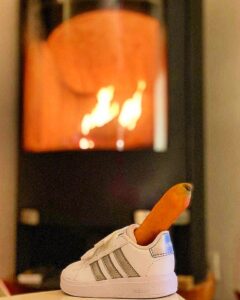
Saint Nicholas in an Italian home
Since Sinterklaas’ arrival in the Netherlands, we faithfully place our shoe by the stove. Not just any stove: a wood-burning one with a chimney pipe so narrow that any helper coming through must be exceptionally slim.
Sophie puts a carrot or an apple in for the horse, and I slip in a note with slightly wobbly handwriting for Saint Nicholas.
In the morning, she finds mandarins, a small book, a note full of compliments, and sometimes, when it’s truly festive, some pepernoten (small, spiced, crunchy Dutch biscuit bites traditionally enjoyed during Saint Nicholas) or meringue treats.
Those usually come from kind Dutch clients, who know exactly that this is the time of year when I feel most homesick. They bring them from the Netherlands, along with a smile and the scent of childhood.
My Italian family has grown to love the celebration. Where they once watched with raised eyebrows, they now fully join in.
A helper knocks loudly on the door, footsteps echo across the tiles, and moments later a sack of gifts appears for Sophie. Here, the helper is still black with soot, and, importantly, very slim.
The laughter and excitement in the house are deafening, because even without a steamboat or costumes, the magic works.
Saint Nicholas of Myra and the bones of Bari
What many Italians don’t realise is that Sinterklaas is, in a way, partly theirs.
Saint Nicholas of Myra, from present-day Turkey, lived in the fourth century and was known for his generosity. Stories tell of him rescuing children from slavery, saving sailors from storms, and secretly placing gold coins in the shoes of the poor.
In the eleventh century, Italian merchants took his remains from Myra and brought them to Bari, where they still rest today in the Basilica of San Nicola. Since then, he has been the patron saint of sailors, children and, surprisingly, thieves. An odd, but telling combination.
So yes, I like to think I’ve simply brought him back home.
A celebration of softness and humour
What I love most about this tradition is not the sweets or the gifts, but the softness it brings.
The anticipation in my daughter’s eyes as she sets out her shoe. The giggle when she thinks she hears footsteps. The scent of mandarins mixing with Italian espresso.
And then, the highlight for grown-ups: surprise night. Gifts wrapped in disguise, hidden jokes, and homemade rhymes.
The first time, my Italian family didn’t quite get the concept. Their “poems” were more like poetic emergencies, such as:
“Cara Yvette, tu sei brava e simpatica,
questo regalo… ehm… non è una magica!
Ma viene dal cuore, senza inganno,
Buon Sinterklaas o come si chiama quest’anno!”
But now they’re learning. They practise rhyming, write with a glass of wine in hand, and laugh at each other’s attempts. It’s a joyful chaos of languages, love, and glue.
Two cultures, one heart
What once was a children’s tradition has become a bridge between worlds. Between the Dutch scent of spiced biscuits and the Umbrian smell of olive wood. Between a saint from Turkey who arrives by steamboat from Spain (not exactly environmentally friendly, but undeniably magical), and a child in Italy who laughs at his mysterious arrival.
And somewhere in between, between pepernoten and panettone, I find a quiet reassurance: that traditions don’t disappear when you move. They simply travel with you and, along the way, take on a new accent.
Yvette


